
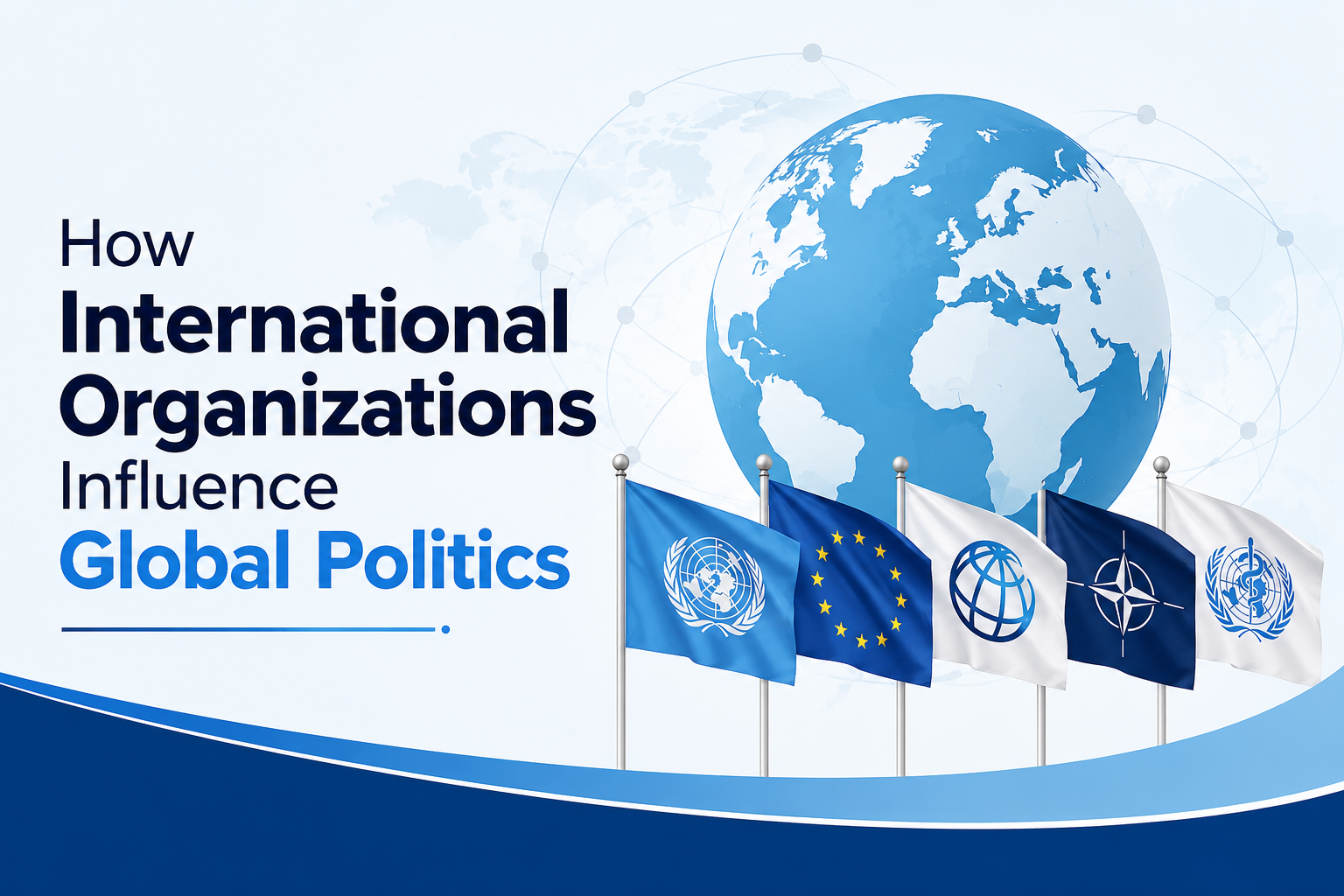
International organizations have quietly become one of the most powerful forces shaping the modern world. From trade rules to peacekeeping missions, these institutions influence how countries behave, cooperate, and compete on the global stage. Whether you follow world news casually or study international relations closely, understanding how international organizations influence global politics helps explain why nations act the way they do.
In this article, we will explore what international organizations are, how they operate, and the specific mechanisms they use to shape global politics. We will also look at real-world examples, criticisms of these institutions, and what the future might hold for global governance.
What Are International Organizations?
International organizations are institutions formed by multiple countries to work toward shared goals. These goals can include maintaining peace, promoting trade, protecting human rights, or responding to global crises like pandemics and climate change.
There are two broad categories of international organizations:
- Intergovernmental Organizations (IGOs) – Formed by agreements between sovereign states. Examples include the United Nations, the World Trade Organization, and NATO.
- International Non-Governmental Organizations (INGOs) – Formed by private groups or individuals across borders, such as Amnesty International or the Red Cross.
While both types play a role in global affairs, IGOs tend to have the most direct influence on political decision-making because member states voluntarily give them authority to set rules, mediate disputes, and enforce agreements.
Why International Organizations Matter in Global Politics
Global politics today is far more interconnected than it was a century ago. No single country can solve problems like climate change, terrorism, financial crises, or pandemics alone. International organizations exist precisely to fill this gap.
They matter because they:
- Provide a platform for diplomacy and negotiation
- Set international laws, norms, and standards
- Offer mechanisms to resolve conflicts peacefully
- Distribute financial aid and development support
- Coordinate responses to global emergencies
- Hold governments accountable to international standards
Without these organizations, international relations would rely almost entirely on bilateral deals and raw power dynamics, making cooperation far more difficult.
Key International Organizations Shaping Global Politics
The United Nations (UN)
The United Nations is arguably the most influential international organization in modern history. Founded in 1945 after World War II, its core mission is to maintain international peace and security.
The UN influences global politics through:
- The Security Council, which can authorize sanctions, peacekeeping missions, and even military intervention
- The General Assembly, where all member states have a voice on global issues
- Specialized agencies like UNICEF, WHO, and UNESCO, which shape health, education, and humanitarian policy worldwide
The UN’s influence is not always about hard power. Often, it works through soft power — setting norms around human rights, refugee protection, and international law that countries feel pressured to follow, even without direct enforcement.
The World Trade Organization (WTO)
The WTO governs international trade rules. It influences global politics by determining how countries can trade with one another, resolving trade disputes, and preventing unfair practices like dumping or excessive tariffs.
When two countries have a trade disagreement, the WTO acts as a neutral arbitrator, reducing the risk of trade wars escalating into larger political conflicts. Its rulings can directly shape a country’s economic policy and, by extension, its political priorities.
The International Monetary Fund (IMF) and World Bank
The IMF and World Bank are two of the most powerful economic institutions in global politics. The IMF provides emergency loans to countries facing financial crises, often attaching conditions related to fiscal policy, subsidies, or governance reforms.
This gives the IMF significant leverage over domestic political decisions in borrowing countries. Similarly, the World Bank funds infrastructure and development projects, often influencing how developing nations prioritize spending and reform.
NATO and Regional Security Alliances
The North Atlantic Treaty Organization (NATO) is a prime example of how international organizations shape military and security politics. By binding member states to mutual defense commitments, NATO changes how countries approach foreign policy, deterrence, and alliance-building.
Regional organizations like the African Union, ASEAN, and the European Union play similar roles in their respective regions, coordinating security policy and political cooperation among neighboring states.
The European Union (EU)
The EU is unique because it goes beyond traditional intergovernmental cooperation. Member states transfer a significant portion of sovereignty to EU institutions, allowing the EU to set binding laws on trade, environmental policy, competition, and even elements of foreign policy.
This makes the EU one of the clearest examples of how international organizations can directly shape domestic political systems, not just international relations.
The International Criminal Court (ICC)
The ICC prosecutes individuals for war crimes, genocide, and crimes against humanity. While its enforcement power is limited, it plays an important political role by shaping global norms around accountability and justice, often influencing how governments and leaders behave during conflicts.
Mechanisms Through Which International Organizations Influence Global Politics
Understanding the specific mechanisms these organizations use helps clarify their real-world political impact.
1. Diplomacy and Negotiation Platforms
International organizations provide neutral spaces where countries can negotiate without the pressure of direct bilateral confrontation. The UN General Assembly, G20 summits, and WTO negotiation rounds all serve this purpose, allowing disputes to be resolved through dialogue rather than conflict.
2. Setting International Norms and Standards
Many international organizations shape what is considered acceptable behavior on the world stage. Human rights standards, environmental agreements like the Paris Climate Accord, and labor standards set by the International Labour Organization all influence domestic policy, even in countries that are not directly bound by enforcement mechanisms.
3. Economic Leverage
Organizations like the IMF and World Bank use financial assistance as a tool of influence. Loan conditions often require structural reforms, which can significantly alter a country’s political and economic direction.
4. Sanctions and Enforcement
The UN Security Council can impose sanctions on countries that violate international law. These sanctions can range from trade restrictions to asset freezes, directly affecting a nation’s political and economic behavior.
5. Peacekeeping and Conflict Resolution
UN peacekeeping missions have been deployed in dozens of conflict zones worldwide. While not always successful, these missions demonstrate how international organizations can directly intervene in political and military conflicts to stabilize regions.
6. Information and Data Sharing
Organizations like the World Health Organization (WHO) influence political decisions by providing data and guidance during global health crises. Government responses to pandemics, for example, are often shaped by WHO recommendations, even when politically inconvenient.
Real-World Examples of International Organizations Shaping Politics
The Paris Climate Agreement
Coordinated through the United Nations Framework Convention on Climate Change, the Paris Agreement pushed nearly 200 countries to commit to climate targets. This reshaped domestic energy policy, industrial regulations, and political debates in countries around the world.
IMF Bailouts and Political Reform
Countries like Greece, Argentina, and Pakistan have received IMF bailout packages tied to austerity measures and economic reforms. These conditions often triggered significant domestic political changes, including shifts in ruling parties and public policy.
UN Sanctions on North Korea
UN Security Council sanctions on North Korea’s nuclear program show how international organizations can isolate a country economically and diplomatically in an attempt to influence its political behavior.
WTO Trade Dispute Rulings
Trade disputes between major economies, such as the United States and China, have frequently been brought before the WTO, influencing tariff policies and broader diplomatic relations between the two nations.
Criticisms and Limitations of International Organizations
While international organizations play a major role in global politics, they are not without criticism.
- Power imbalances: Wealthier and more powerful nations often have greater influence within these organizations, such as permanent Security Council members holding veto power.
- Limited enforcement: Many international organizations lack the ability to enforce their decisions, relying on voluntary compliance from member states.
- Sovereignty concerns: Critics argue that international organizations can undermine national sovereignty, especially when economic or political conditions are attached to assistance.
- Slow decision-making: Reaching consensus among dozens or hundreds of member states can be slow, especially during urgent crises.
- Selective application: Sanctions and interventions are sometimes seen as inconsistently applied, depending on political alliances rather than pure principle.
These limitations do not eliminate the influence of international organizations, but they do shape how effective that influence can be in different political contexts.
The Future of International Organizations in Global Politics
As global challenges become more complex, the role of international organizations is likely to evolve rather than shrink. Several trends are shaping this future:
- Rising influence of regional organizations like the African Union and ASEAN as global power becomes more multipolar
- Increased focus on climate governance, with organizations playing a central role in coordinating global climate policy
- Digital governance and cybersecurity becoming new frontiers for international cooperation
- Reform pressure on institutions like the UN Security Council to better reflect today’s global power balance
- Greater involvement of non-state actors, including multinational corporations and NGOs, in shaping international policy discussions
Despite ongoing criticism, international organizations remain central to how global politics functions. Their ability to bring nations together, even imperfectly, continues to shape economic policy, security arrangements, and diplomatic relationships worldwide.
Conclusion
International organizations influence global politics in ways that touch nearly every aspect of international life, from trade and security to human rights and public health. Institutions like the United Nations, WTO, IMF, NATO, and EU shape not only how countries interact with one another but also how domestic political decisions are made.
While these organizations face real limitations and criticisms, their role in providing platforms for diplomacy, setting global norms, and coordinating responses to shared challenges remains essential. As the world becomes more interconnected, understanding how international organizations influence global politics is more important than ever for anyone trying to make sense of today’s international landscape.
Frequently Asked Questions
What is the main purpose of international organizations in global politics? Their main purpose is to facilitate cooperation between countries on shared challenges such as security, trade, human rights, and economic development, reducing the likelihood of conflict.
Which international organization has the most political influence? The United Nations is generally considered the most politically influential due to its near-universal membership and its Security Council’s authority over global peace and security matters.
Can international organizations force countries to follow their rules? Enforcement varies widely. Some organizations, like the WTO, have binding dispute mechanisms, while others, like the UN General Assembly, rely more on diplomatic pressure and international norms.
How do international organizations affect a country’s economy? Organizations like the IMF and World Bank can directly influence economic policy through loans, financial assistance, and reform conditions tied to that assistance.
Are international organizations becoming more or less powerful? Their influence is evolving. While some institutions face criticism and calls for reform, new challenges like climate change and cybersecurity are creating fresh areas where international cooperation is increasingly necessary.